 English
  Arabic
Why does the Arab woman drain her energy in roles she never chose? And how does a retreat bring her back to her original self?
There is a kind of tiredness that sleep cannot heal.
A tiredness a woman wakes up from as if she had not slept at all. She opens her eyes to find a long list of tasks waiting for her before she even drinks her coffee. A child who needs her, a husband who is waiting, a mother calling, work chasing her, a home demanding her attention, and a society watching.
She gets up. She smiles. She gets things done.
And at the end of the day, when she sits alone for a few brief minutes, a strange feeling rushes in — one she does not dare to name:
“I no longer know who I am after all of this.”
This is not depression.
It is not weakness.
It is not a lack of gratitude.
This is what we call: the tired feminine.
The roles we never chose
Since childhood, the Arab woman receives her roles the way one receives an inheritance: without being asked whether she wants it.
She is raised to be a “good wife,” then a “perfect mother,” then a “dutiful daughter,” then a “loving sister,” then a “loyal friend,” then a “hardworking employee,” then a “strong woman who does not break.”
At least seven roles in a single day, moving between them with the smoothness of a professional.
But no one ever asks her:
Who are you when you take off all these roles?
And because no one asked, she stopped asking herself.
This is where the silent disaster begins: when a woman lives an entire life without meeting herself even once.
Why is our tiredness different?
The tiredness experienced by the Arab woman is not ordinary tiredness. It is a layered exhaustion made up of three levels:
The first layer: physical exhaustion.
Long hours of giving, interrupted sleep, rushed meals, and a nervous system in a constant state of alert.
The second layer: mental exhaustion.
A mind that never stops planning, remembering, worrying, and apologizing. A woman carries invisible lists in her head, and responsibilities that are not counted in any budget.
The third layer — and the most dangerous one: identity exhaustion.
To live every day as someone else, and gradually forget the features of the person you were before all these roles. To look in the mirror and see a woman you recognize by name, but no longer know what she loves, what brings her joy, or what makes her feel alive.
This kind of tiredness cannot be healed by a short vacation, a cup of tea on the balcony, or ten hours of sleep.
Because it is not tiredness from work.
It is tiredness from being absent from yourself.
What happens when you keep going?
A woman who continues giving without returning to herself passes through three silent stages:
First: she loses feeling.
She no longer feels joy the way she used to, nor sadness the way she used to. Her emotions become muted, and her days begin to look the same.
Second: she loses desire.
She no longer knows what she wants to eat, where she wants to travel, or what she wants to do with her free time — if free time even exists.
Third: she loses her voice.
Her inner voice becomes so quiet that she can no longer hear it. She begins living according to other people’s expectations, measuring her success by their standards, sleeping and waking to their rhythm.
And here, even if she appears “fine” from the outside, she has actually lost the most important relationship in her life: her relationship with herself.
A retreat is not a luxury. It is a return.
Many women believe that a retreat is a luxurious trip, a fancy vacation, or “too much self-indulgence.”
But the truth is much deeper than that.
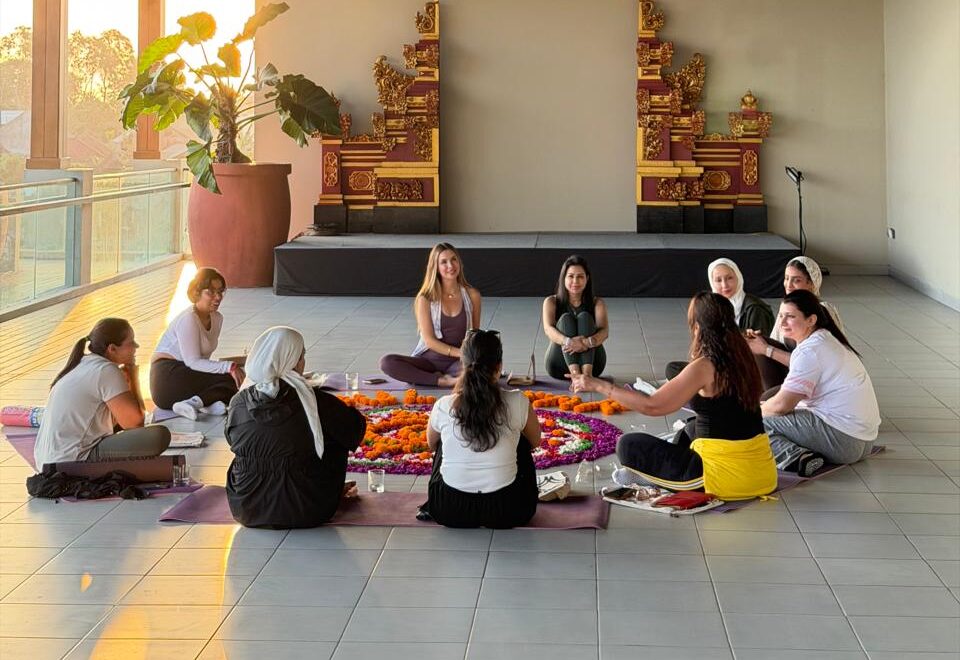
A retreat — when designed consciously — is the only space in the life of an Arab woman where nothing is required from her.
No one is waiting for food from you.
No one is waiting for you to reply to a message.
No one needs your opinion on a decision.
No one is evaluating your performance as a mother, wife, or daughter.
For the first time in years, you are simply you.
And in this sacred emptiness, something happens that does not happen anywhere else:
Your nervous system begins to calm after years of being on alert.
Your body starts to remember how to breathe deeply.
Your inner voice becomes audible again — first as a soft whisper, then as a clear conversation.
And you meet, perhaps for the first time in a long while, the woman you were before all the roles.
How does a retreat bring you back to your original self?
Your original self is not a lost person.
She is a forgotten person buried beneath layers of expectations.
A retreat does not create a new self for you — it removes what is not truly you.
Through practices of silence, meditation, yoga, conscious breathing, and body-based practices that release the memory of exhaustion, you gradually begin to:
Distinguish between what you truly want and what you were taught to want.
Reclaim your ability to say “no” without guilt.
Rediscover what brings you joy — not as a mother or a wife, but as a woman.
Build a new relationship with your body, one based on listening instead of ignoring.
Return to your home, your family, and your work — but this time, with yourself by your side.
A final message
If you are reading this now and feel something moving inside you, know that this is not a coincidence.
It is your inner voice, the one that has been patiently waiting for you to turn toward it.
You do not have to be strong all the time.
You do not have to be everything for everyone.
You do not have to prove anything to anyone.
You deserve to return to yourself.
Not because you are exhausted, but because you exist.
And the return begins with one decision.
Do you feel that the time has come to meet your original self?